What Will Your Legacy Be?
At The Mustard Seed, a legacy gift isn’t just a donation, it is a seed that grows into lasting change for people you may never meet.
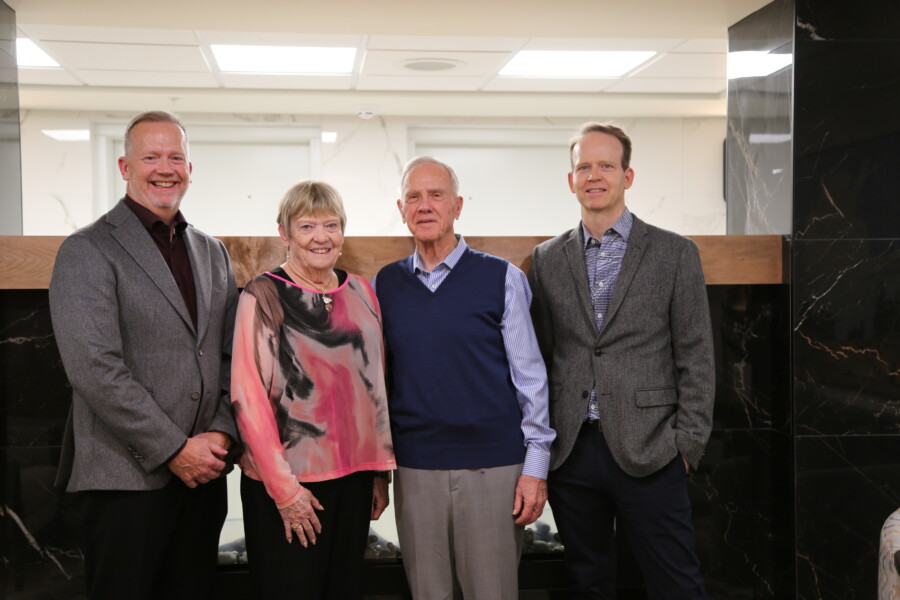
Gord Tallman and his family understand this, and they’re shaping their family estate with purpose, choosing The Mustard Seed as part of the legacy they are building today.
Legacy Planning is All In The Family
When it comes to legacy planning, engaging your family early in the process is the best way to go. Gord Tallman’s approach is a fine example of how to do it right. The retired bank executive and former MRU Foundation chair and his wife Beverley are working closely with their sons Scott and Mike to plan their financial and philanthropic legacy. Gord Tallman says his approach is guided by the example set by his parents who inspired him to value family and community service. His father was a decorated Second World War veteran who died shortly after returning home. His widowed mother worked as a nurse while raising Gord and his four siblings.
Gord and Bev and their sons have built a team whose mission is to ensure the financial future of the Tallman grandchildren as well as to create a robust and wide-ranging philanthropic legacy that will benefit several worthy causes important to them.
“My wife, and two sons have been involved from the start,” says Gord. “We call it the Tallman family inheritance plan. We started drawing it up about 25 years ago. There’s no formal structure, it’s mostly communicating about the assets and setting priorities that includes family, health, friends, education, faith, home, charitable giving and building a financial foundation for future generations.”
Their present inheritance plan and wills provide support to all inheritors to build a financial foundation for the present three generations as well as provisions to support the fourth generation as well as some extended family members. It also clearly spells out provisions to support several charitable organizations including The Mustard Seed.
The Tallman siblings contribute their expertise to help strategize. Mike has a background in finance while Scott, a retired lawyer, focuses on charitable giving. “We meet with our external advisors at least once a year and as a family three times a year to go over my parents’ estate, “says Scott. “We review their wills and see if anything needs to be changed based on the priorities. Dad has a ‘simplicity is a sharp tool’ attitude and we stick to that.”
It’s no surprise that Gord has gathered his immediate family members together as his estate planning team. The former Senior Vice President of RBC attributes much of his success to the power of teams. He says, “Individuals get things done … teams create miracles!”
Ways to Give
A Will Is Not Enough
Gord points to research conducted by Royal Bank to illustrate the value of the family approach. The bank’s study on estate planning says that if you don’t involve family members early on, heirs could end up with less money than you intend, with more going to taxes and fees; yet a survey shows that only 37 percent of people feel comfortable talking to their children about their inheritance plan.
It’s worth remembering that a will has three beneficiaries: your loved ones, your philanthropic partners, and the Canada Revenue Agency (CRA). An efficient estate plan, with appropriate family input, will ensure your loved ones and your charities of choice will receive the funds you intend for them with a considerable tax savings.
Sending Wealth Forward
Gord says the book Wealth of Wisdom by Tom McCullough and Keith Whitaker has some valuable ideas to consider when you are thinking about your estate. For example, it suggests “you’re not so much leaving your wealth behind, you are sending it forward.” In fact, the Tallman family is already sending wealth forward in the form of scholarships at Mount Royal University and the University of Calgary in the name of Gord and Beverley’s late son David.
They have also established scholarships at Support Our Troops in memory of Gord’s parents, Guy and Marian Tallman. The recipients of the scholarships are single parents or members of military families. The Tallman family have had the opportunity to witness the impact of philanthropy on transforming lives of students and how it is strengthening their families. Scott says he enjoys his role in supporting the Tallman family legacy. “Getting involved in the philanthropic side of my parent’s estate planning is the best part of this experience,” adds Scott.
Gord Tallman and his family personify the true spirit of generosity. The family’s strategic estate plan will not only provide for heirs, but will also have a far-reaching impact on Canadian society through a range of benefactors and charitable contribution methods.
Estate Gifts
Gord and his family have identified several charities that are important to the family and are identified in the estate. After family members receive their gifts, charitable gifts are paid from the estate based on a percentage of allocation designated for each charity.
Living Estate Gifts (LEGs)
The family has been using annual Living Estate Gifts (LEGs) for five years. Living Estate Gifts are transfers of money, property, or other valuable assets made during the owner’s lifetime rather than after their death. This concept was taken from the book The Happy Inheritor by Thomas William Deans, Ph.D., and the Tallman’s refer to significant donations made to the charities identified in the estate as Living Estate Gifts.
“Better to give with a warm hand than a cold heart” – Philip Roth
Impact Gifts
The family uses Impact Gifts for significant charitable donations to charities not currently receiving estate gifts but are still important the family.
Annual Gifts
For charities that don’t qualify for either Estate or Impact gifts, an annual budget is established by the family, and donations are distributed as annual gifts.
Special Occasion Gifts/Donations
Gordon asks his family and friends for donations to charities rather than receiving gifts on special occasions. The donor always keeps the tax receipt.
May is Legacy Giving Month, a time to reflect on the kindness you’re planting now and how it can grow into something that supports our vulnerable neighbours for generations to come. To learn more, visit TheSeed.ca/legacy-giving